Back Room or Hosted Hall: Placing 181 TH/s in the Right Building
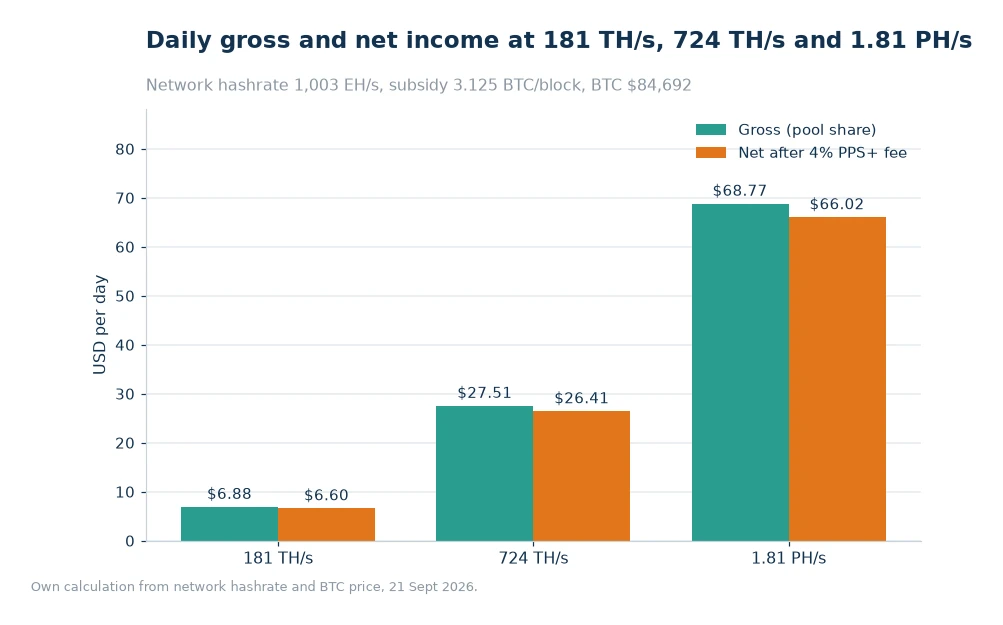
181 TH/s returns about 0.00008121 BTC a day, which is $6.88 at $84,692 and roughly $6.60 after the listed 4% on the block-reward component. That credit does not care whether the machine hums in a spare office or in a rented hall. What changes is the bill that arrives beside it: rent, cooling, noise and the hands that replace a dead fan.

Key takeaways
- One 181 TH/s unit earns 0.00008121 BTC a day before fees, or $6.60 net at BTC $84,692.
- A hosted slot only works when its all-in daily charge sits clearly under that credit.
- Listings differ on what the rate covers: building and staff, a power drop only, or repairs included.
- Worker names, payout address and alerting remain the miner's in either arrangement.
What the directory is actually listing
The ViaBTC Mining Companies page gathers operators that will run hardware they do not necessarily own. Read each row as a bundle rather than as a price. One operator supplies the building, the power feed, the cooling loop, the network and the technicians who walk the aisles. Another rents a rack position and a breaker, and leaves everything above that to the customer. A third folds repairs and spare parts into the rate. These are three products, not three quotes for the same thing.
The same page also covers Miner Hosting, the label for providers that accept third-party machines instead of building a fleet of their own. Treat the directory as an inventory of what you would stop owning. If an entry never says who pays for a failed hash board, whether spares sit on site, or how long a unit may stay dark before someone looks at it, the entry is incomplete for a buyer with one pallet. A listing shortens the search. It does not answer the questions that decide the arithmetic.
The home bill arrives as noise and time
At home the electricity is metered, but the cooling, the floor space and the labour are not on any invoice. A single 181 TH/s machine turns a spare room into a room nobody wants to sit in while it runs. The fan pitch decides where the box can live, the heat decides how hard the air conditioning has to work, and the person who notices a dark board at midnight is the owner.
Those costs do not scale down with hashrate. One unit carries the whole fixed burden of a site: a dedicated circuit, a network drop, a habit of checking alerts, somewhere to put the spares. At $6.60 a day the cash margin is thin, so the home option has to win on more than money. It wins when the room already exists, the noise reaches nobody, and the owner is around anyway. It loses when the machine is in a space that could earn something else.
The same credit at any address
The payout formula takes hashrate, network total and subsidy, and it never asks where the hardware stands. Four times the hashrate returns four times the coins, which is why scale changes the hosting question without changing the mining result. At 724 TH/s the day is worth 0.00032483 BTC, or $27.51 gross and $26.41 after the listed 4%. At 1.81 PH/s it is 0.00081206 BTC, or $68.77 and $66.02.
Fixed charges behave in the opposite way. A connection fee, a minimum slot, a monthly administration charge and a contract minimum are the same number whether the rack holds one machine or forty. That is the whole reason a hobby rig usually stays home while a pallet travels: not because the pool pays a large account more per terahash, but because a large account spreads the site's fixed cost over more coins.
What stays in your name
The machines move; the account should not. Worker names, the payout address, two-factor settings, alert thresholds and the pool URL all belong to the miner, and a host needs none of them to do its job. What a technician needs is the ability to see a machine's boards, temperatures and error counts, and permission to power-cycle it. What a technician does not need is the ability to redirect where coins are paid.
Before shipping anything, write down the serial numbers, the firmware version on each unit, the expected hashrate per board and the exact worker string each machine reports. In the first week, compare the host's dashboard against the pool's own Statistics page. If the host reports 181 TH/s and the pool credits at the rate for 181 TH/s, the handover is clean. A gap between the two is easier to argue about in week one than in month six.
A pallet-sized threshold
Run the comparison in one currency. Take the daily net credit at your hashrate and subtract the all-in daily cost of the slot, including cooling surcharge and any minimum commitment. Leave a margin for a difficulty change: the next estimate on 21 Sept 2026 was −2.12%, which would lift output per terahash slightly, and the reverse move is just as ordinary. A contract that only clears when difficulty falls is not clearing.
Three clauses decide more than the headline rate. The first is the power price, stated per kilowatt-hour with every surcharge named. The second is uptime: what happens to the fee when the site loses power or a machine waits for a part. The third is exit: how much notice, who pays for crating, and whether the hardware leaves with the serials it arrived with. An operator who answers all three in writing is comparable with another. One who answers only the first is not.
| Scale | BTC per day | Gross USD | Net USD | Net USD per TH/s |
|---|---|---|---|---|
| 181 TH/s | 0.00008121 | $6.88 | $6.60 | $0.0365 |
| 724 TH/s | 0.00032483 | $27.51 | $26.41 | $0.0365 |
| 1.81 PH/s | 0.00081206 | $68.77 | $66.02 | $0.0365 |
Worked example
Start from the network and work down to one machine, then to a month.
- The network mints 450 BTC a day: 144 blocks, each with a 3.125 BTC subsidy.
- Spread across 1,003,000,000 TH/s of network hashrate, one terahash is worth 0.00000044865 BTC a day.
- Multiply by 181 TH/s: 0.00008121 BTC a day.
- Value it at $84,692: 0.00008121 × 84,692 = $6.88.
- Apply the listed 4% to the block-reward component: 6.88 × 0.96 = $6.60.
- Thirty days: 6.60 × 30 = $198.05 before power or hosting.
- At 724 TH/s the same steps give 0.00032483 BTC, $27.51, and $26.41 net; at 1,810 TH/s they give 0.00081206 BTC, $68.77, and $66.02.
- A quote of $5 a day at 181 TH/s would leave $1.60; the same quote at 1.81 PH/s would leave $61.02. Same rate, different verdict.
Frequently asked questions
Does a hosted machine earn less from the pool?
No. At 181 TH/s the pool credits 0.00008121 BTC a day in a hall exactly as it would in a back room, because the calculation uses hashrate and difficulty rather than the address where the hardware sits.
Which listings should a single-pallet owner read first?
Start with entries that state what the rate includes, because a power-only quote and a full-service quote are not comparable until both are converted into one all-in daily figure at your hashrate.
What should stay under my control after moving in?
The pool account, worker names, payout address and alerting. A host needs enough access to diagnose and restart a machine, not the ability to change where the coins are paid.
Price the room before you sign
Write the daily net credit at your hashrate on one line and the all-in daily cost of the slot on the next. If the first line is larger by a margin that survives a difficulty swing, the arrangement holds. If the two are close, no amount of facility quality fixes the arithmetic, and the machine is better off where the space is already paid for.
The Profit Calculator produces the first line in dollars at current difficulty, and the second line is a question for the operator. Do the comparison once at 181 TH/s and once at the size you expect in a year, because a contract signed for one machine is often renewed for ten.
Sources: ViaBTC companies and calculator pages for listing categories and the listed 4%[1]. Inputs as read on 21 Sept 2026: BTC $84,692, network hashrate 1,003 EH/s, difficulty 132.76 T, 3.125 BTC per block over 144 blocks a day. Published 24 Oct 2026; credits assume continuous uptime.