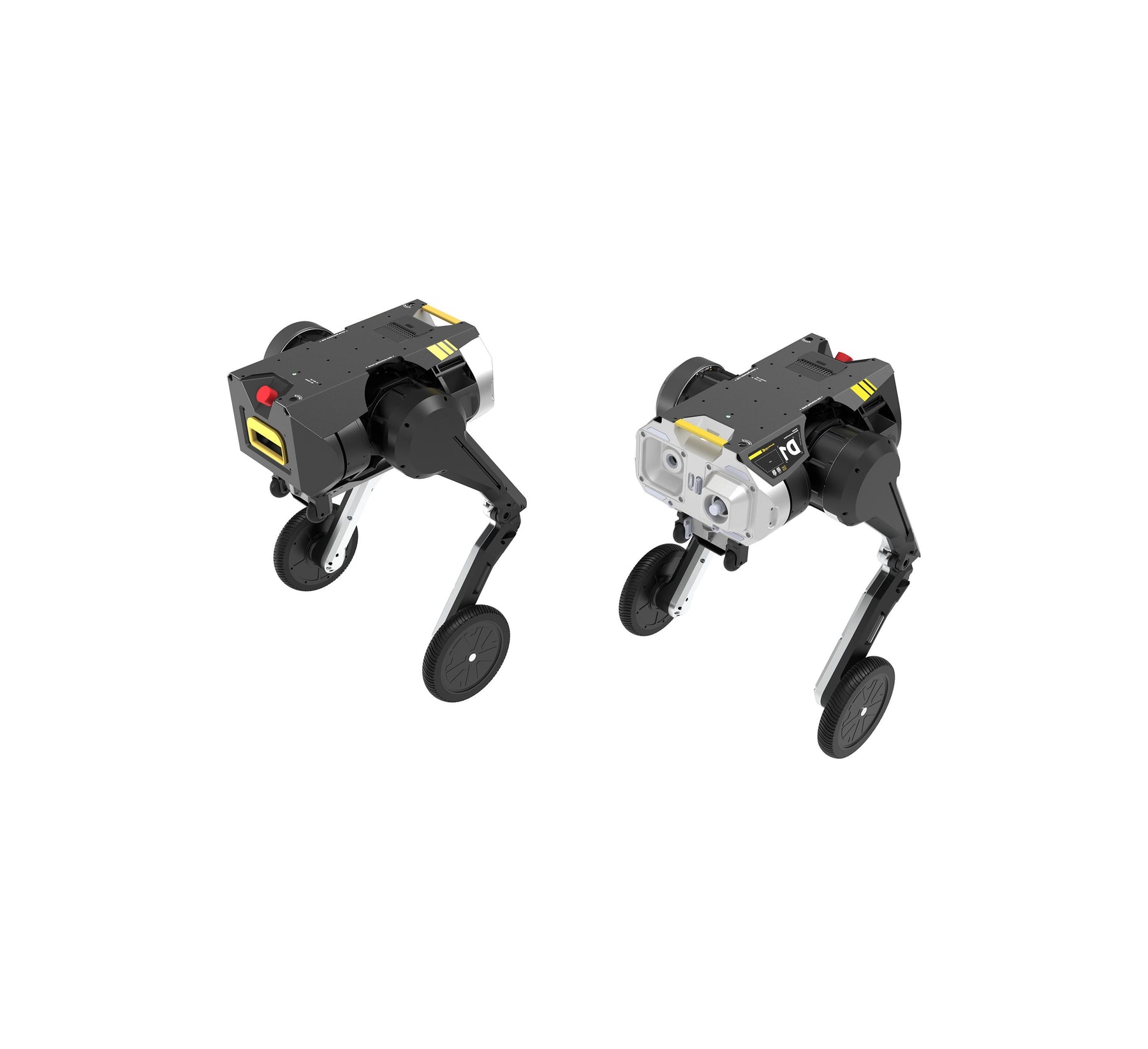
Single and double D1 robot configurations support different research scales, with single units focusing on autonomous control, perception, and mobility validation, while double units enable multi-robot cooperation studies. A single D1 platform reduces variables during algorithm testing, whereas a double setup allows researchers to evaluate communication, coordination, and task sharing. In 2025, embodied robot configurations became increasingly important for universities and laboratories developing physical AI systems, where repeatable hardware platforms are needed for datasets, validation, and long-term robotics research.
Research programs often begin with a single robot configuration because it provides a controlled environment for evaluating robotic capabilities. A single D1 robot allows researchers to study navigation, sensor processing, motion control, and artificial intelligence models without additional interaction factors from other robots.
In many academic projects, one robot is sufficient for collecting baseline data. For example, a navigation study may evaluate 500–1,000 autonomous movement trials to compare different planning algorithms, measuring indicators such as path completion rate, positioning accuracy, and energy consumption.
A single robot platform helps researchers separate software performance from multi-agent communication issues during early development stages.
The single D1 configuration is suitable for universities and research laboratories working on perception and control systems. Cameras, depth sensors, inertial measurement units, and onboard computing modules allow researchers to test how robots understand and respond to physical environments.
Since 2020, robotics research has increasingly moved from simulation-based development toward real-world validation. Studies in embodied AI have shown that physical interaction data can improve model performance because robots must handle environmental changes, sensor noise, and unexpected situations.
The main research applications of a single D1 configuration include:
| Research Field | Typical Study Content | Example Evaluation |
|---|---|---|
| Autonomous navigation | Mapping and route planning | Success rate over 100+ navigation trials |
| Motion control | Stability and movement optimization | Walking accuracy and recovery ability |
| Computer vision | Object and scene recognition | Recognition accuracy under different lighting |
| Reinforcement learning | Policy training | Reward improvement over training cycles |
| Human-robot interaction | Response behavior | Interaction completion rate |
After individual robot performance has been evaluated, research programs often expand toward multi-robot studies. The double D1 configuration introduces additional variables, including communication between robots, shared environment understanding, and coordination methods.
A double robot setup allows researchers to study how two autonomous systems divide tasks and exchange information. For example, one robot can collect environmental information while another performs a related task, creating conditions similar to future warehouse, inspection, and service robotics applications.
The development of embodied robot configurations reflects this shift from isolated robot capability toward systems where multiple physical agents operate in the same environment. More information about D1 platforms can be found at D1 Robot Configurations.
Two-robot configurations provide a practical environment for testing cooperation methods before expanding to larger robot groups.
Compared with a single platform, a double D1 configuration requires additional software design. Researchers must consider communication frequency, information sharing methods, and coordination accuracy. A navigation algorithm that achieves 95% success with one robot may require additional optimization when two robots operate simultaneously.
The comparison between the two configurations can be summarized as follows:
| Category | Single D1 Configuration | Double D1 Configuration |
|---|---|---|
| Robot number | 1 unit | 2 units |
| Research focus | Individual autonomy | Robot cooperation |
| Data type | Single-agent data | Multi-agent interaction data |
| Software complexity | Lower | Higher |
| Suitable projects | Algorithm testing and education | Coordination and communication research |
Single configurations are often used during the first stages of research because they simplify testing. Researchers can modify one parameter at a time and observe changes in robot performance. This approach is common in robotics laboratories where repeatability is required.
For example, a locomotion project may test different control models using one robot across 50–200 repeated trials. Researchers can compare movement stability, energy use, and response time under identical conditions.
The double configuration extends these studies by adding interaction scenarios. Two robots can perform cooperative navigation, object transportation, environmental exploration, or task allocation studies. These experiments generate additional datasets that cannot be collected from a single robot.
Multi-robot research has expanded rapidly since 2018, especially in areas such as autonomous warehouses and mobile inspection systems. Research groups increasingly evaluate not only whether a robot can complete a task, but also whether multiple robots can coordinate efficiently in the same space.
A double D1 configuration allows researchers to evaluate communication and cooperation without requiring a large-scale robotic fleet.
The hardware selection between single and double configurations depends on research objectives, available testing space, and project maturity. A laboratory focused on control algorithms may only require one robot, while a group studying distributed intelligence may benefit from two synchronized platforms.
The cost and management requirements also differ. A single robot requires fewer maintenance resources and simpler data processing pipelines. A double system increases hardware requirements but provides more research possibilities.
| Project Type | Recommended Configuration |
|---|---|
| Undergraduate robotics courses | Single D1 |
| Robot perception research | Single D1 |
| Reinforcement learning studies | Single or double D1 |
| Multi-agent AI research | Double D1 |
| Cooperative navigation | Double D1 |
| Robot communication studies | Double D1 |
The transition from single to double configurations can also support long-term research planning. Researchers can first establish reliable control systems using one robot and later introduce another robot when communication and coordination algorithms are ready.
This approach is commonly used in robotics development because hardware platforms remain consistent while research complexity increases gradually. A laboratory using the same robot family for both single and double setups can compare results more easily across different projects.
The growing use of physical AI after 2023 has increased demand for flexible robot platforms that support both individual and cooperative studies. Research programs need hardware capable of collecting reliable physical data, testing algorithms, and supporting different experimental designs.
Single and double D1 configurations provide two research paths within the same robotic platform. The single setup supports detailed analysis of individual robot abilities, while the double setup allows researchers to study interaction between autonomous systems.
Choosing the appropriate configuration allows research teams to match hardware capability with their specific goals, from basic mobility testing to advanced multi-robot cooperation studies.
For future robotics programs, flexible configurations will remain important because autonomous systems are expected to operate in increasingly complex environments. A platform that supports both single and double robot research gives laboratories more options for education, algorithm development, and applied robotics studies.