Setting Expectations for AI Sex Chat Technology
Most disappointment with adult AI chat comes from expecting the wrong thing rather than from getting a bad one. The technology is very good at producing continuous, responsive text that remembers what came before, and it does not produce photographs or video at all — the platform states plainly that its content is AI-generated text and depicts no real person. Those two facts set the whole expectation range.

Key takeaways
- Strong at text: continuity within a session, recall across sessions, and instant change of direction.
- Not a media service: the site states it does not produce images or video, and no real person is depicted.
- Rules still exist: the FAQ says some limitations apply under the content and community guidelines.
- Ratio arithmetic helps set expectations too — 7.1K favourites against 24.3M views is about 0.029%, so most readers do not keep most cards.
What the technology reliably does
Crushon describes its characters as Sex AI companions with responses that are natural and adaptive, and four capabilities inside that description are dependable. It holds a conversation together across a session, so a premise set at the start is still available forty messages later. It recalls earlier interactions, which is the platform's own description of the memory behaviour, so a second visit is not a blank page. It responds to direction immediately, meaning a change of tone or pace shows up in the next reply rather than next week. And it costs almost nothing to redirect when a thread stops working.
The economics of iteration are what make those four useful together. In most creative work, changing direction halfway through means discarding what you built. Here it means sending one message that says so. That is a genuine advantage, and it is the reason so much of the good usage advice in this area is about clarity of direction rather than about finding hidden settings.
Where expectations usually overshoot
The first overshoot is medium. A reader who expects to see something will be disappointed, because the product is text. The platform is specific: the content is AI-generated text, no real person is depicted, and the site does not produce images or video. That sentence is not marketing caution; it is the specification.
The second overshoot is about boundaries. Unfiltered describes the general tone of the catalogue, not the absence of rules, and the platform's FAQ notes that some limitations apply under its content and community guidelines. A reply that declines something is working as documented. Treating it as a malfunction leads to repeated rephrasing, which wastes more time than accepting the boundary and moving the scene sideways.
The third overshoot is memory. Recall is real and it is not total. Characters remember previous interactions, which is a long way from remembering everything verbatim, so anything that matters should be restated once rather than assumed. Two seconds of restating beats ten minutes of wondering why a detail vanished.
Testing a claim instead of trusting it
Every claim above can be checked inside one session. Send a detail, run twenty messages, and see whether the detail is still available. Ask the character something only an earlier message would answer. Send a direct instruction about tone and read the next reply. Each of these tests takes a minute and produces evidence rather than an impression, which is what expectation-setting actually needs.
It also helps to test on the catalogue rather than on the marketing. The counters on ranked cards are a useful reality check: 7.1K favourites against 24.3M views on the leading card is about 0.029%, which implies that the overwhelming majority of readers look and move on. A technology that satisfies roughly one in three thousand viewers of a given card is still a useful technology, as long as nobody expected universal delight.
| Expectation | What is documented | One-session test |
|---|---|---|
| Visual content | Content is AI-generated text; no real person is depicted; the site does not produce images or video | Nothing to test — treat the product as text by design |
| Continuity in a session | Characters recall previous interactions and adapt over time | Set a detail, run 20 messages, ask the character about it |
| Instant redirection | Responses are described as natural and adaptive | Send one tone instruction, read the next reply |
| Total recall | Recollection, not an archive | Restate an old detail and see whether it returns |
| No restrictions at all | Some limitations apply under the content and community guidelines | Read the reply to a borderline request and redirect |
| Typical keep rate | Card counters: 7.1K from 24.3M is about 0.029% | Favourite a card, then check whether you return |
Worked example: calibrating on the counters
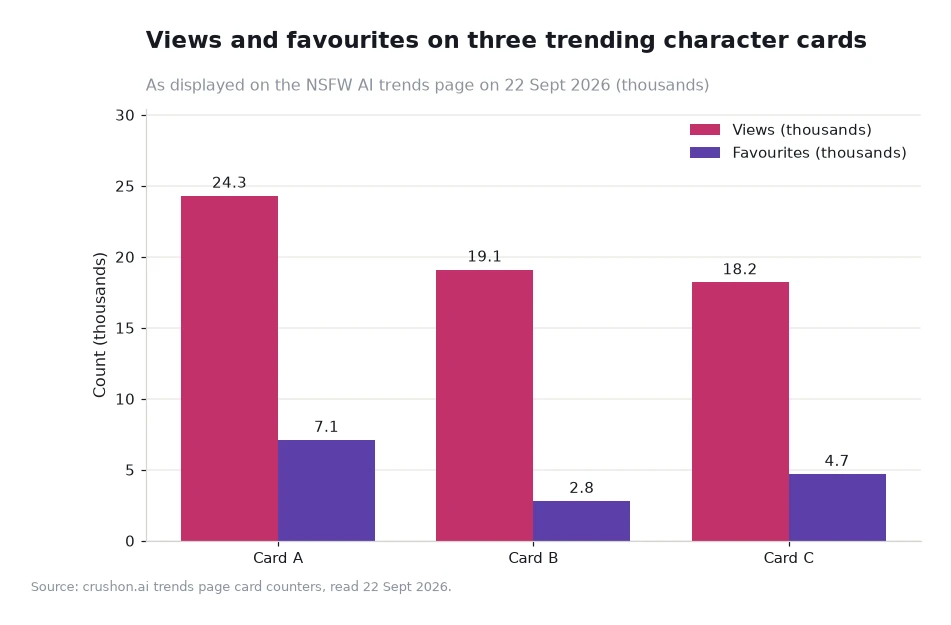
Take the published figures as a baseline for expectations. Eri is listed with 24.3M views and 7.1K favourites: 7,100 ÷ 24,300,000 ≈ 0.029%. Eva lists 19.1M and 2.8K, giving about 0.015%. Takara lists 18.2M and 4.7K, about 0.026%. Read as a benchmark, this says that a good card in a large catalogue is kept by a small fraction of the people who open it.
Put a personal month alongside that. On the illustrative 16-session month of 30-minute sessions, a reader spends 480 minutes, or 8 hours, and might save something like two to twelve new characters — the range used in the chart below, where a library grows from 2 saves to 42 over six months. The gap between 8 hours of use and a handful of saves is not a failure; it is what a selective habit looks like, and expecting every session to produce a keeper is the fastest way to be disappointed by a product that is working normally.
Expectations for a sex ai habit that holds up
Expect text, expect direction to work, expect recollection rather than total recall, and expect a few boundaries under the guidelines. That set is narrow enough to be accurate and wide enough to be useful, and it makes the good outcomes reproducible: a clear direction, a consistent register, and a willingness to restate what matters.
It also makes evaluation honest. A platform judged against text-only criteria can be compared with another text-only platform meaningfully, and the platform's own description of a private and secure environment provides the wording for the privacy side without needing to be extended. Readers who want the mechanics explained before committing can read the AI chat blog, which is easier than inferring behaviour from a handful of sessions.
Frequently asked questions
Does the platform produce any images or video?
No. Its compliance statement says the content is AI-generated text, that no real person is depicted, and that the site does not produce images or video. The product is a text conversation and should be judged as one.
If it is unfiltered, are there any rules?
Yes. Unfiltered describes tone rather than the absence of rules, and the platform's FAQ states that some limitations apply under its content and community guidelines. A refusal is a boundary working as documented.
How much should I expect it to remember?
Characters recall previous interactions, which means earlier conversations can inform later ones. It is recollection rather than an archive, so restating anything important once is sensible rather than a sign that something is broken.
Right-size the expectation, then enjoy the product
Decide before the first session that this is a text service with real continuity and documented limits, and most of the friction disappears. Then run the three cheap tests — continuity, redirection, recollection — and calibrate from what you observe rather than from what the category promises. The product is easier to like when it is measured against what it says it does.
Data and sources: the Crushon AI sex chat page for the platform's own product wording[1], the porn chat page FAQ for restrictions and privacy wording[2], and the 2257 statement for the AI-text and no-real-person claims[3], read 22 Sept 2026. The session and library figures are illustrative arithmetic rather than platform data. For an adult audience of 18 and over.