Owner Apps and Remote Diagnostics for EV Owners
Half of modern ownership happens on a phone, and the difference between a good and a frustrating car is often how much of it can be handled without a workshop visit. XPENG lists remote diagnostics as standard on its Australian vehicles, alongside an owner app for scheduling and seven years of roadside assistance from first registration. Here is what those tools cover and where the dealer still matters.

Key takeaways
- The owner app handles maintenance and service scheduling, so the diary entry exists before the reminder does.
- Remote diagnostics are listed as standard and can sometimes resolve a problem without a workshop visit.
- Roadside assistance runs for 7 years from first registration, on 1800 255 494, with 24/7 coverage of most of Australia.
- Anything needing parts, a hoist or hands-on work still goes through an XPENG Authorised Dealer.
What the owner app is actually for
Strip away the marketing and an owner app does four jobs. It records the car and its service history, it schedules and books maintenance, it reports the state of the vehicle, and it acts as the account for charging features. On this platform the app-linked functions include a charging schedule that can be set for off-peak hours, plug-and-charge so no card is needed at the bay, a Smart Guard anti-theft lock on the cable and multi-account sharing so two drivers can use the same car without juggling keys or credentials.
The scheduling side is the one that pays for itself. Servicing falls due every 12 months or 20,000 km, whichever comes first, and the recommendation is to have it done through an XPENG Authorised Dealer. Diarising that in the app the day you take delivery means the first service is booked before anyone has to remember it, and the logbook stays complete for whoever buys the car after you.
Remote diagnostics: what can be fixed from a desk
Remote diagnostics are listed as standard on the Australian models, and the manufacturer is careful about the claim: some issues can be diagnosed or resolved remotely, which is different from saying nothing ever needs a workshop. In practice a technician can read fault codes over the mobile network, confirm whether a warning is a genuine hardware problem or a software glitch, and in the second case push a fix or clear the condition.
Software updates arrive the same way. The cockpit runs Xmart OS with an OTA-upgradable interface, delivered over Wi-Fi or a mobile network, so interface changes and fixes can land while the car sits in the driveway. In-car scene modes can be customised, and the seats in the New G6 are power-reclining in Nappa leather where the configuration allows - availability of that trim varies by configuration, so check your build rather than the showroom car.
Roadside assistance and the dealer network
Roadside assistance is published as seven years from first registration, contactable on 1800 255 494, with 24/7 coverage of the majority of Australia. That is a long tail of cover by the standards of the market, and it pairs with the ownership terms: whole vehicle warranty of seven years or unlimited kilometres for private use, key parts of eight years or 160,000 km covering traction battery, battery management system, drive motor and intelligent power unit, paint at five years with no distance limit and anti-corrosion at seven years.
Keep the boundaries in mind. Warranty covers defects under the terms in the XPENG ANZ Warranty and Maintenance Manual - Australia; roadside assistance covers the situation on the road; insurance covers accident damage. Know which one applies before you ring anyone, because the first question on the phone will be the same whichever number you call. Spare parts and accessories are handled through the same dealer channel, and Owner Connection is the published contact route for questions that do not fit anywhere else.
| Situation | First step | Published detail |
|---|---|---|
| Service due | Schedule it in the owner app | 12 months or 20,000 km |
| Warning light or fault | Let remote diagnostics check | Some issues can be resolved remotely |
| Breakdown or flat tyre | Call roadside assistance | 7 years from registration, 1800 255 494 |
| Long trip planning | Plan stops around rapid charging | 10-80% in 12 minutes |
Worked example: a 1,000 km trip planned from the app
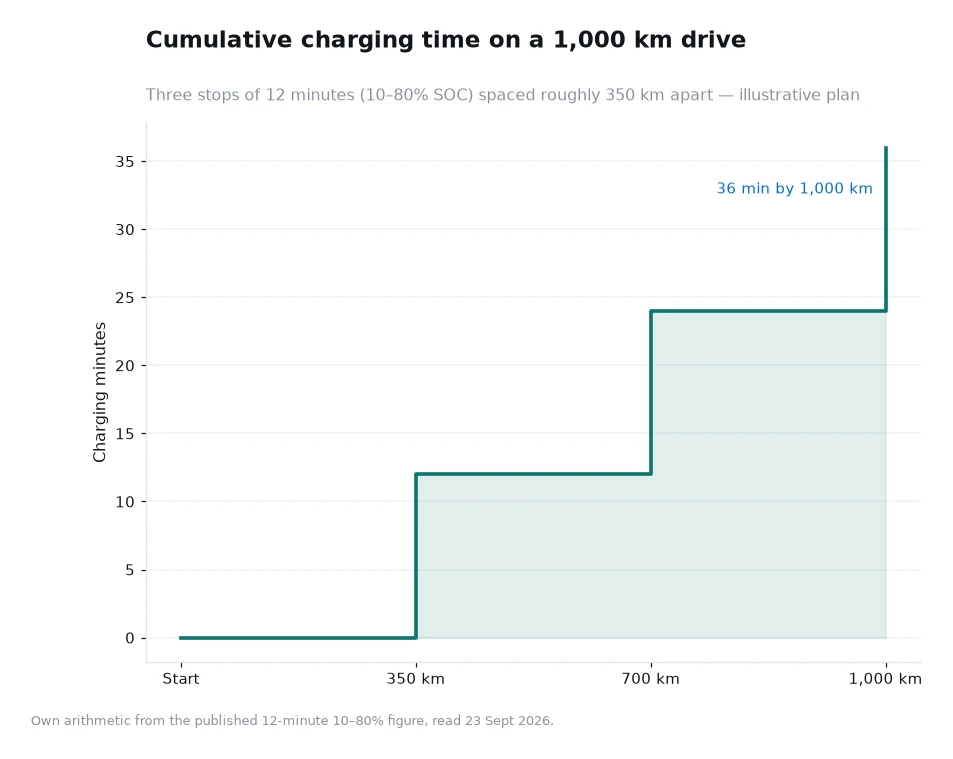
Assume a 1,000 km interstate drive and stops planned at roughly 350 km, 700 km and 1,000 km, each held to the published 10-80% window of 12 minutes. Three stops at 12 minutes each add up to 12 + 12 + 12 = 36 minutes of charging for the whole trip. Spread across 1,000 km, that is 0.036 minutes of charging for every kilometre, or 3.6 minutes per 100 km.
Set that against driving time. At an assumed average of 100 km/h, the trip takes about 10 hours, or 600 minutes, so the charging share is 36 divided by 600, which is 6%. Put the two long trips most households make each year on that basis and the annual total is 72 minutes of charging - less time than a single afternoon in a waiting room. The point of the app is planning the stops at all, since the arithmetic only works when the car arrives at each charger with a battery in the fast part of its charging curve.
Two boundaries are worth drawing before you need them. The first is that remote diagnostics work best on software and sensor faults, so anything mechanical - a tyre, a wheel bearing, a stone through a condenser - still needs a workshop booking. The second is that updates and diagnostics depend on connectivity, which is patchy across parts of rural Australia; if the car sits where there is no signal, say so when you ring the dealer rather than assuming the remote check has failed. Phone with the app's fault report in hand and the conversation starts several steps further along.
There is a quieter benefit to setting the app up properly. A charging schedule that runs overnight keeps the car ready for the morning without any attention, and multi-account sharing means a second driver can see the same state of charge rather than asking. Over a year those small conveniences matter more than any single line on a specification sheet, because they remove the daily decisions that make a switch to an electric car feel unfamiliar to a household.
Frequently asked questions
Can a fault be fixed without visiting a dealer?
Sometimes. Remote diagnostics are listed as standard, and the manufacturer notes that some issues can be diagnosed or resolved without a workshop visit. Anything needing parts or hands-on work still goes through an XPENG Authorised Dealer.
How long does roadside assistance apply?
Seven years from first registration, with 24/7 coverage of the majority of Australia. The published contact number is 1800 255 494.
Set the app up on day one
The best time to configure any of this is the afternoon you collect the car, while the dealer is still a phone call away. Pair the app, set the charging schedule, save the roadside number somewhere you can find it without signal, and book the 12-month service into your calendar. Ten minutes of admin then saves a lot of guessing later.
For the underlying terms, read the manufacturer's own service information rather than relying on a summary, and check the model pages for the XPENG electric suv equipment list so you know which app-linked features your build includes. If a seven-seat layout matters, the XPENG X9 pages cover the same ownership tools on the larger car.
Support terms, remote diagnostics, service intervals and warranty figures come from the manufacturer's Australian site, read 23 Sept 2026; remote diagnostics can sometimes resolve an issue but do not remove the need for dealer servicing, and the trip arithmetic above is an illustrative example with assumed inputs.[1]