Installation, Commissioning and Operator Training in One Contract
The handover is where a brewery project succeeds or slips, and it is far easier to manage when installation, commissioning and training sit inside one contract rather than three. Hermann describes a turnkey scope that runs from a business plan to the first brew, with technical support and installation included, so the same team that built the vessels also proves them on your site. This article sets out what a complete handover package should contain when you buy a hem craft beer equipment set, and how to check it arrived in full.
Key takeaways
- One contract should cover delivery, mechanical installation, water and pressure testing, commissioning and operator training, with named dates for each.
- Every tank arrives with a data plate carrying its pressure-testing record and serial number, so commissioning starts with documents rather than assumptions.
- Warranty cover of 6 years on tank accessories and electronic components against manufacturing defects from the factory, used within scope, is the baseline to keep in the signed wording.
- Sales and engineers keep 24 hours online, with after-sales service on a 7x24 basis, which is the fallback when a first brew does not behave as predicted.
What belongs in a handover contract
A handover contract should say who unpacks the crates, who sets the vessels level, who connects steam, water, glycol and power, who runs the first water trial, who brews the first batch, and who signs the plant off. Equipment is packed in wooden boxes and arrives with a checking list, so the receiving step is a documented comparison rather than a count of pallets. If the contract lists installation as a line item without naming the boundary — for example, who provides the final electrical connection from the wall to the control cabinet — that boundary becomes a change order on site. Put the utility interfaces in writing at quotation stage, when they are still free to define.
Installation: what your site must be ready for
Installation is mostly a site-readiness test. The manufacturer needs level floors with the load capacity for filled vessels, drainage where the mash and cleaning water will go, headroom above the kettle for steam and hop access, and pipe routes already decided. When those four things are settled before the crates land, a typical installation runs in days; when they are not, the crew waits on a concrete contractor and the schedule absorbs the cost. It is worth photographing the floor and the service wall before shipping, and sending the pictures to the design team, because a two-dimensional layout can hide a beam, a pillar or a doorway that will not pass a 2,000 litre vessel.
Commissioning: proving every vessel and loop
Commissioning turns an assembly into a brewery. Each vessel is filled, the jackets and pipework are pressure tested, pumps are checked for rotation and flow, the heat exchanger is proved at temperature, and the control system is walked through state by state until the sequence behaves. This is the stage at which the five inspection steps recorded before shipment are verified again in working conditions, and at which small mismatches — a backwards valve handle, a sensor reading a few degrees out — get corrected while a crew is still on site. Ask for the commissioning record to be handed over in writing, with the readings it contains, because that record becomes the baseline for every maintenance decision afterwards.
Operator training is what protects the warranty
Training is cheaper than a rebuild and it is where warranty cover actually lives: the published terms are 6 years on tank accessories and electronic components against manufacturing defects from the factory, provided they are used within scope. A team that has never seen a CIP cycle or a glycol setpoint is a team that will exceed design conditions by accident. Training should therefore cover the cleaning cycle, the cooling loop, the control panel's alarms, and the correct way to bring a vessel up to pressure and down again. Two days of structured sessions with the people who will actually run the shift — not only the head brewer — is a normal and worthwhile ask.
An extra benefit of the same exercise is a written operating note the brewery keeps. Manuals written for engineers rarely survive contact with a night shift, while a one-page cleaning and pressure checklist pinned beside the tank does more for consistency than a folder in the office. If a second team joins later, those notes are what carry the original method forward without another site visit and another commissioning bill.
| Handover item | What it should contain | Example planning allowance |
|---|---|---|
| Delivery and unpacking | Wooden crates, checking list, data plates matched to the equipment list | 1-2 days |
| Mechanical installation | Vessels level, pipework connected, platform and valves fitted, glycol loop closed | 3-5 days |
| Commissioning | Fill, pressure test, pump and heat exchanger checks, control sequence walk-through, written record | 3-4 days |
| Training | Cleaning cycle, cooling, control panel alarms, pressure and fill procedure for shift staff | 2 days |
Worked example: what a two-week handover actually contains
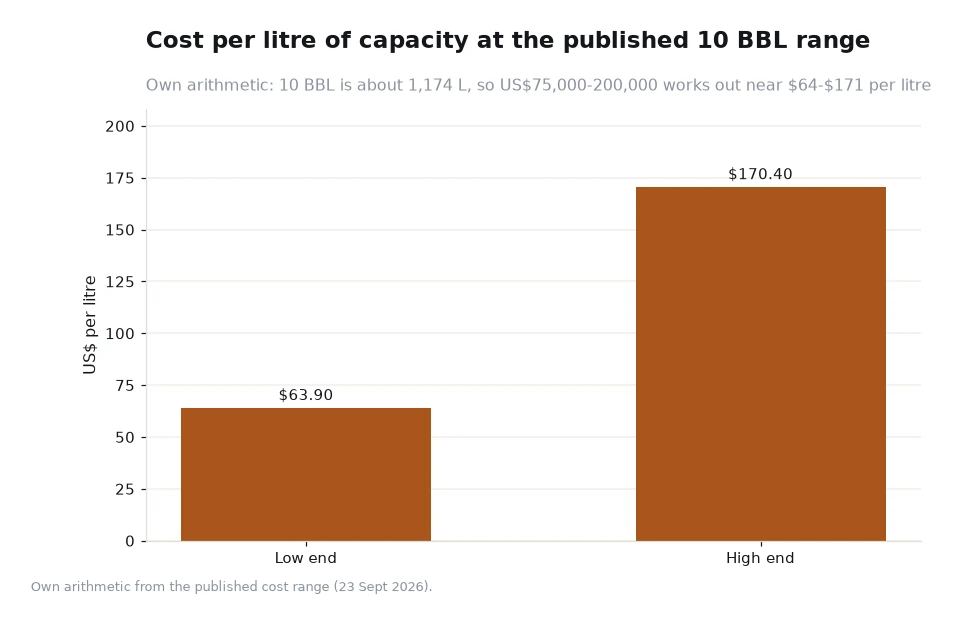
The schedule below is an example, and every assumption is stated. Assume a 1,000 litre brewery with four fermentation tanks, a single installation team of two engineers working 9-hour days, and a site that is ready when the crates arrive. Days 1 and 2 are delivery, unpacking and matching the checking list: 2 days x 2 engineers x 9 hours = 36 engineer-hours. Days 3 to 7 are mechanical installation and utilities, 5 days x 2 x 9 = 90 engineer-hours. Days 8 to 10 are commissioning, 3 x 2 x 9 = 54 engineer-hours. Days 11 and 12 are training, and here the arithmetic changes shape: 2 days x 9 hours = 18 hours of trainer time, but six operators attending both days receive 6 x 18 = 108 operator-hours of instruction. The total manufacturer time is 36 + 90 + 54 + 18 = 198 engineer-hours over 12 working days. For context on the money side, the published example of a complete 10 BBL system is US$75,000-200,000; divided by 1,174 litres that is about US$64-171 per litre of capacity, and a handover that avoids a single week of downtime is usually the line that pays for itself fastest.
Frequently asked questions
Does installation and training normally come with the equipment?
It can, and it should be written into the contract: the published turnkey scope includes equipment installation, commissioning and operator training, so name the dates and the interfaces rather than assuming them.
What warranty cover should a new brewery expect in writing?
Cover of 6 years on tank accessories and electronic components against manufacturing defects from the factory, used within scope, with sales and engineers keeping 24 hours online for support.
Sign the handover only when the paperwork matches the plant
Before the last engineer leaves, walk the plant against the checking list, the data plates and the commissioning record, and make sure the training notes stay in the brewery rather than in an email inbox. Ask what spare parts the manufacturer recommends holding on site and how quickly replacements normally ship, because the answer turns into the maintenance plan for the next few years. A supplier with 23 years of craft brewing experience, installations in more than seventy countries and after-sales cover around the clock is set up for that conversation, and the company profile is a reasonable place to start it. Keep the same support contact for the first six months: the questions that come up in that period are the ones worth asking.
Installation, training, warranty and after-sales wording above come from the manufacturer's own website at hembrewing.com, read on 23 Sept 2026; the day counts, engineer-hours and cost per litre are our own labelled examples. Re-check the published terms before you sign[1].