Sample approval is the stage where fragrance projects lose the most time, and the perfumer is rarely the reason. Approvals stall because nobody agreed in advance what a sample is judged against, who is allowed to judge it, and what happens to the version everyone liked three weeks ago. A short protocol, agreed before the first sample arrives, removes most of that friction.
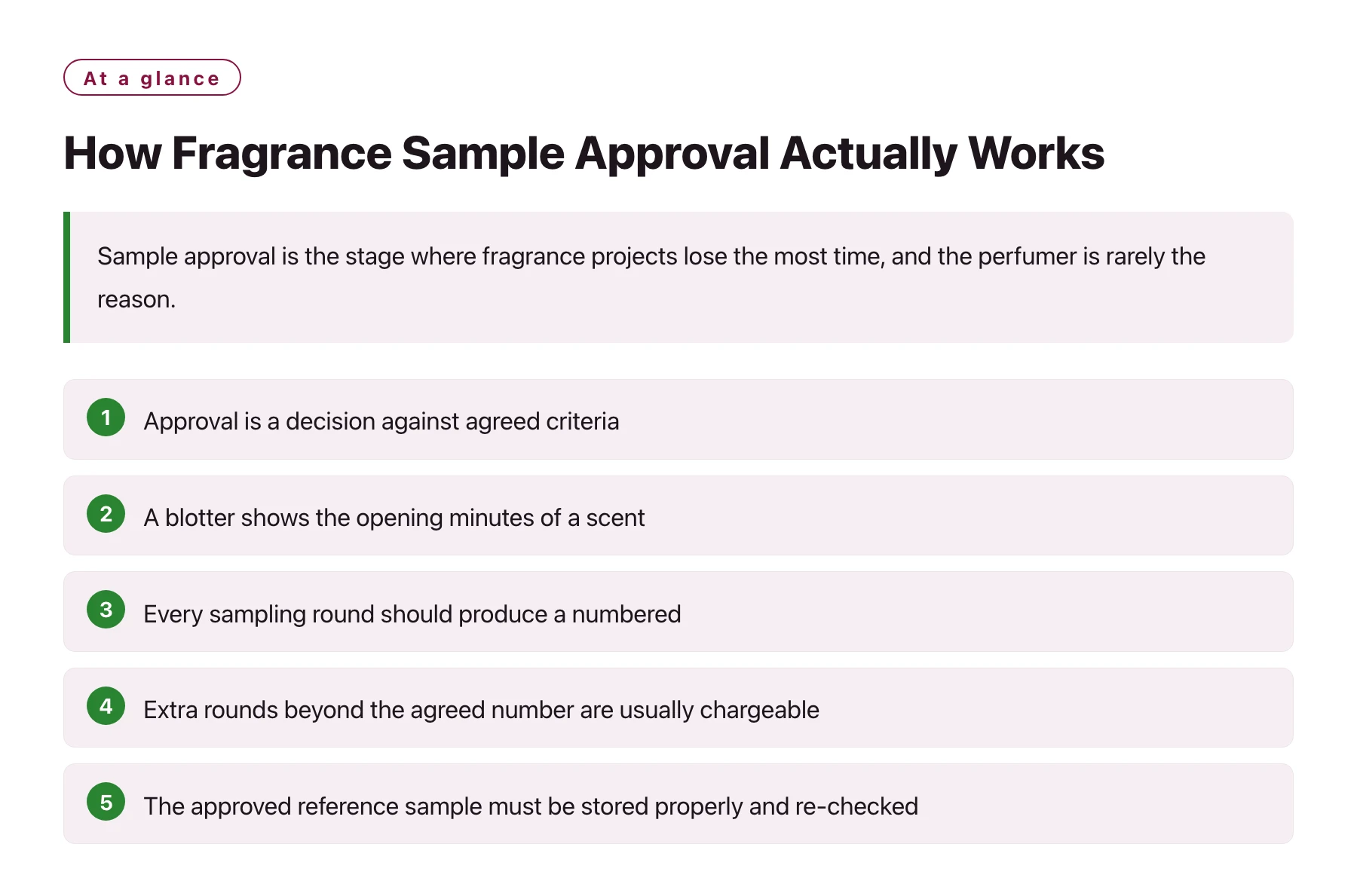
Key takeawaysApproval is a decision against agreed criteria, so the criteria should be written before the first sample is smelled rather than after it disappoints. · A blotter shows the opening minutes of a scent; only skin shows the dry-down, which is the part a customer lives with all day. · Every sampling round should produce a numbered, documented reference, because unlabelled bottles are the most common cause of lost decisions. · Extra rounds beyond the agreed number are usually chargeable, so the round count and the scope of revisions belong in the original brief. · The approved reference sample must be stored properly and re-checked, because it becomes the standard against which every bulk batch is judged.
Ask five brand owners how their last fragrance was approved and you will usually hear five different stories. One approved from a blotter in a meeting room, one ran an informal panel, one simply said yes to the third sample out of fatigue. All five ended up with a product, and most of them later disagreed with the factory about whether the bulk batch matched what they had signed off.
The gap is not a lack of care. It is that approval is treated as a moment rather than a process, so decisions are made without a record and are re-made later from memory.
This walkthrough breaks the loop into its parts: what is being decided, who decides, what evidence is required, and how the result is preserved.
What approval is actually deciding
An approval decision contains two separate judgements that are usually merged into one conversation. The first is conformity: does this sample match the brief we wrote? The second is commercial acceptability: would our customer choose it?
Keeping them apart matters, because a formula can satisfy one and fail the other. A sample can follow the brief exactly and still be dull in the market, and a sample everyone loves can be built on materials that will not survive the price point.
Criteria belong in the brief, not the meeting
Conformity can only be measured against something written down. A brief that names the character, the intensity at a stated moment, the intended wear time and any colour constraint gives the perfumer a target and gives the brand a checklist.
When the brief is only a mood board and an adjective, the first sample is effectively the brief, and every later round becomes a negotiation about taste rather than a correction of direction.
One approver, several evaluators
Evaluation benefits from more noses, but approval needs one signature. Collecting opinions from sales, marketing and the founder produces a useful picture, and it also produces contradictions that stall a project for weeks if nobody has the authority to resolve them.
Name the approver before sampling starts and let that person own the final call. Evaluators advise; the approver decides.
Blotters are for shortlisting, not for signing
Paper shows how a formula opens and how it behaves in the first minutes, which is exactly what you need when comparing ten directions. It says very little about the two-hour and six-hour marks, when the materials that actually define the product are still on the skin.
A practical loop is to shortlist on blotters and approve on skin, with at least a few people wearing the sample through a normal day.
A six-step approval loop that keeps version control
- Freeze the brief in writingRecord the character, intensity, wear target, format, market and price ceiling so later rounds are judged against a fixed document.
- Ask for numbered samples with matching sheetsEvery sample should carry a version number and a short description of what changed from the previous round.
- Evaluate on skin at set intervalsAgree the checkpoints in advance, then record the verdict against each criterion rather than a general impression.
- Return structured feedbackSay what should move and by how much, since a note that reads slightly sweeter gives the perfumer nothing to work with.
- Approve one reference and store it properlyKeep the approved sample in a sealed, labelled container at a stable temperature, with a copy held by each side.
- Re-test the reference before bulk productionCompare the first bulk batch against the stored reference before filling continues, not after the goods are packed.
What each stage of the loop should produce
| Stage | What is being checked | Typical failure mode | What you should receive |
|---|---|---|---|
| Direction selection | Whether the proposals answer the written brief | Judging from a two-minute blotter smell | A short description of each direction and its main materials |
| First lab sample | Character, intensity and wear against the criteria | Feedback given only as adjectives | A numbered sample with a matching formula summary |
| Revision rounds | Whether the change followed the instruction | Unlabelled bottles and lost versions | Sequential version numbers and a note of what changed |
| Base compatibility | Whether the compound behaves in the intended carrier | Assuming a lab sample equals a finished product | Compatibility and stability results before approval |
| Final approval | Whether one reference is locked as the standard | No stored reference, approval recalled from memory | A signed reference retained by both sides |
Notice that only one row is about smell. The rest are about records, which is why projects with modest budgets often approve faster than larger ones: fewer people are involved, so the version trail stays short and legible.
The expensive mistake is approving from a blotter in a meeting room because the schedule is tight. That decision follows the project all the way to the bulk batch, where the first real disagreement appears and neither side can prove what was agreed. Spray it on skin, wait, and write the verdict down. If a supplier runs development and filling under one roof, as Xuelei does, it can also keep the approved reference and compare the bulk batch against it, which turns the argument into a measurement.
The details that decide whether approval sticks
Once the loop is running, three practical details separate projects that approve cleanly from projects that approve three times.
None of them is technical, and all of them are cheaper to fix before sampling than after.
Adjectives are not specifications
Material databases such as The Good Scents Company collect odour descriptions and usage information for aroma materials, and they are useful precisely because a material name is unambiguous where a word like fresh is not [1]. When feedback says fresher, the perfumer has to guess which of several routes you mean; when it says more of the citrus top and less of the green, the instruction is testable.
The same logic applies to the base. Formulation and testing coverage in specialist titles such as Cosmetics & Toiletries reflects how much of a product's behaviour is settled by the carrier rather than the compound [2], so a brief that fixes the perfume and leaves the base open is fixing the smaller half of the problem.
Restrictions follow the format, not the scent
The IFRA Standards Library publishes use restrictions that vary by product category, which is why a formula approved for one format is not automatically cleared for another [3]. Moving the same scent from a body mist to a concentrated oil is a change in the compliance question, not just in the packaging.
In the European Union, certain fragrance allergens must be declared once they pass set thresholds in the finished product, and the scientific opinions behind such assessments are published by the relevant committee [4]. Both checks belong before final approval, because changing a formula afterwards can reopen artwork and notification work.
Version control is a habit, not a software purchase
Numbered samples, a dated note of what changed and one stored reference will carry almost any project. Manufacturers such as Guangzhou Xuelei that have run sampling programmes for years tend to keep references from completed projects for exactly this purpose, which makes a re-order or a line extension considerably easier to brief.
The habit also protects the brand. When a supplier changes hands or staff move on, the reference bottle is often the only surviving record of what the product was supposed to smell like.
Sources
- The Good Scents Company —— A reference database of aroma materials with odour descriptions, CAS numbers and typical usage information.
- Cosmetics & Toiletries —— A technical magazine for cosmetic formulators, covering ingredients, formulation science and testing methods.
- IFRA Standards Library (International Fragrance Association) —— The IFRA Standards Library lists the restrictions the fragrance industry applies to individual fragrance ingredients, based on safety assessments; it is the reference point for compliant fragrance formulation.
- EU Scientific Committee on Consumer Safety (SCCS) —— The EU scientific committee that issues opinions on the safety of cosmetic ingredients, including fragrance allergens and their labelling thresholds.
Frequently asked questions
How many sample rounds should a fragrance project need?
It depends on how specific the brief is and how decisive the approver is, so a fixed number is misleading. What matters is agreeing the included round count in the brief, since additional rounds are normally chargeable, and keeping every round documented so progress is visible.
Can I approve a fragrance from a paper blotter?
You can shortlist from one, but approval is safer on skin. Paper shows the opening minutes clearly and says little about the dry-down, which is the part of the wear most customers actually experience. Spray the finalists on several people and check them several hours later before signing.
What is a reference sample and why keep one?
It is the exact approved sample that later production is compared against. Keeping a sealed, labelled copy at a stable temperature gives both sides an objective standard, which turns a subjective dispute about whether a batch matches into a straightforward comparison.
Why does the bulk batch smell different from my approved sample?
Common causes are a short resting period before filling, a different carrier ratio in the bulk batch, or evaporation during storage. Ask the manufacturer to confirm the resting time and to compare the bulk batch against the stored reference before the goods are packed.
Should feedback on a sample be given by one person?
Collect opinions from everyone who will sell or use the product, but let one named person make the final call. Group feedback is valuable for spotting problems and unreliable as a decision, because contradictions between departments stall projects that a single approver could have moved forward.